

Hyvid Predictions 2027: Why the Future of Work Is ‘AI and Human’ Adjacent

The AI workforce will increasingly become part of board-level planning as businesses rethink how people and technology work together. In 2027, organisations will need to reconsider who performs work, how tasks are completed and who remains accountable for the outcomes.
Angela Vidler, Managing Director and Co-Founder of Hyvid, predicts that AI will become part of the board’s workforce agenda. She also expects businesses to redesign workflows and change how they assess global talent. As AI agents take on more tasks, capability and output will become stronger measures of value than labour costs alone.
The AI Workforce Will Sit Alongside the Human Workforce on the Board Agenda in 2027
For decades, boards have managed their human workforce through headcount, remuneration, capability, succession planning and organisational structure. Meanwhile, AI and automation have largely remained part of the technology agenda. Vidler predicts that this distinction will begin to change in 2027.
AI agents are moving beyond experimentation and into business processes, where they perform defined tasks and increasingly execute work. As a result, Vidler expects boards to treat AI as a workforce issue rather than simply a technology investment. She predicts boards will begin asking the same fundamental questions about AI systems that they traditionally ask about employees:
- What is it responsible for?
- Who owns it?
- How is it performing?
- What decisions can it make?
- What data can it access?
- And who is ultimately accountable when it gets something wrong?
Vidler expects the conversation to move beyond “Are we using AI responsibly?” to “Do we actually know what our AI workforce is doing?” This will also change how organisations approach workforce planning. An organisation may employ 500 people, but its operational capacity could increasingly depend on employees, AI-augmented workers and autonomous systems.
Headcount alone will therefore provide an incomplete picture of what an organisation can deliver. Boards will need greater visibility into where AI assists employees, increases individual capacity or independently performs defined workflows.
Vidler predicts that boards will need workforce plans covering both employees and AI systems. This would extend workforce planning beyond traditional employee numbers and organisational structures.
2027 Will Be the Year Businesses Move from Experimenting with AI Agents to Redesigning Work Around Them
Vidler expects the conversation around generative AI to become more operational in 2027. Rather than asking “Where can we use AI?”, businesses will increasingly ask “How should this work be redesigned now that AI can do part of it?” The focus will shift towards redesigning workflows as AI agents take responsibility for more tasks.
Microsoft’s 2026 Work Trend Index found that active agents in the Microsoft 365 ecosystem grew 15x year-on-year. Among large enterprises, that growth reached 18x. Microsoft’s research also found that organisations gaining the most value were redesigning workflows and deliberately dividing responsibilities between people and AI. Among its most advanced AI users, workflow redesign and multi-step agent use were already becoming established practices.
Deloitte’s 2026 research identified similar expectations among business leaders. It found that 74% of surveyed leaders expect nearly half their business processes to be redesigned or rebuilt around AI agents within four years. Meanwhile, 61% expect most agents they use to operate with general autonomy under human oversight. However, only 5% of organisations reported that their business processes were highly prepared for AI agents.
Vidler sees this gap as evidence that businesses will need to focus on redesigning work rather than simply purchasing additional AI tools. She does not expect the transition to follow a straightforward “AI replaces the employee” model. Instead, employees may become responsible for supervising, validating, and managing larger volumes of work.
Under this model, people would increasingly provide judgment, accountability, context, and exception handling. AI agents would take on more repetitive execution. Deloitte’s research also found that 75% of surveyed executives believe collaboration between humans and AI agents creates more value than AI agent automation alone.
Vidler argues that competitive advantage will come from redesigning workflows rather than accessing the same AI models as competitors. Businesses will need to determine which responsibilities remain human, which tasks AI can assist with, and which can be delegated to agents. They must also establish where human handoffs occur and how they evaluate and govern outputs.
Microsoft’s 2026 research found that organisational factors account for more than twice the reported AI impact of individual factors. These factors include organisational culture, manager support and talent practices. The findings support Vidler’s expectation that businesses will need to reconsider how work operates across their organisations.
Rather than simply asking “Can AI do this?”, Vidler proposes a different question: “What is the right combination of human judgement, AI capability and governance for this piece of work?” She expects this to become a defining workforce question in 2027.
Businesses that simply introduce AI into existing jobs may achieve incremental productivity gains. However, Vidler predicts that organisations redesigning work around employees, AI-augmented roles and autonomous agents will develop a fundamentally different workforce model.
AI Won’t Replace Global Talent, but It Will Fundamentally Change What Businesses Expect from Them
Vidler predicts a significant shift in how businesses approach offshore and global talent over the next 12 months. Rather than focusing primarily on accessing skilled workers at lower costs, organisations will increasingly look to build AI-integrated global teams. The objective will be to increase the amount of work each person can deliver.
She does not expect this to become a simple “AI replaces global talent” story. Instead, AI-enabled employees may take responsibility for substantially larger volumes of work. This would change the economics of global teams, alongside the skills businesses require, employee expectations and career paths.
According to Vidler, the next phase of offshore and global staffing will focus on combining people and technology to improve capability. Businesses will increasingly assess the performance of these combined teams rather than simply seeking the cheapest capable workers.
AI Agents Will Become Part of Workforce Planning, Not Just Technology Planning
Traditional workforce planning has focused on employee numbers, required skills and where people work. Vidler predicts that this model will become less effective as AI agents take responsibility for more tasks. In 2027, she expects organisations to increasingly include AI agents in workforce planning and organisational design rather than treating them solely as technology investments.
Deloitte’s 2026 research identifies workforce planning as one of four priorities for organisations adopting agentic AI. The other priorities are governance, strategy and trust. Its research on AI-enabled strategic workforce planning also describes a shift from traditional headcount models towards skills, tasks, roles and capacity.
According to Deloitte, scenario planning is becoming more continuous rather than remaining an annual exercise. Vidler expects workforce planning to increasingly consider human roles, AI-augmented positions and digital workers within a single operating model. Organisations would then allocate responsibilities around the combination of human judgement and machine execution required.
By 2027, Vidler predicts that workforce planning will increasingly focus on the capacity an organisation needs and the combination of people and AI required to deliver it. Employee numbers will remain part of that assessment, but headcount alone will no longer describe the organisation’s full workforce capability.
About Angela Vidler
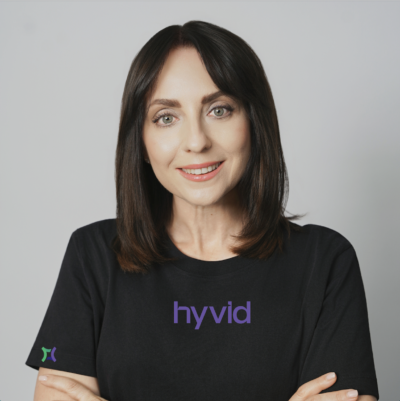
Angela Vidler is Co-Founder and Managing Director of Hyvid. The AI-integrated global staffing company pairs skilled professionals in the Philippines, India and Sri Lanka with purpose-built AI coworkers for Australian businesses. Hyvid’s approach focuses on improving team capability rather than reducing staffing costs alone.
Previously, Vidler served as Managing Director of Diversify Offshore Staffing Solutions. During her leadership, the business grew from 15 to more than 1,500 employees across three locations in the Philippines, while staff turnover remained below 4%. She also led its $40m sale in 2022 to a subsidiary of National Stock Exchange of India-listed Hinduja Global Solutions. The transaction achieved what the source describes as an industry-high 8× multiple.
Vidler began her career at PwC before holding senior people and operations roles at King & Wood Mallesons and DibbsBarker, where she served as Chief Operating Officer. She later co-founded Hynes Legal, a technology-focused law firm. Her qualifications include a Bachelor of Commerce, a Master of Business in Human Resource Management, and graduation from the Australian Institute of Company Directors (GAICD).
She speaks on AI and the future of work, founder wellbeing, and women leading in male-dominated industries.
About Hyvid
Hyvid was founded in 2026 in response to changing approaches to work and workforce management. Its founders have more than 15 years of experience building and scaling global teams. The company combines skilled professionals and AI systems within an integrated workforce model.
In 2010, Robert Hynes founded Diversify Offshore Staffing, which Angela Vidler and Yjez Batulan later joined. Together, they grew the business to more than 1,500 professionals before its acquisition by NYSE-listed HGS in 2022.
Hyvid’s founders believe traditional offshoring focused heavily on labour costs, while future staffing models will increasingly depend on combining people with intelligent systems. They established Hyvid to integrate global talent and AI rather than adding AI to existing staffing structures.
The company says its model brings people and AI systems together from the outset. Its stated focus is helping businesses build distributed teams designed around capability and performance.