
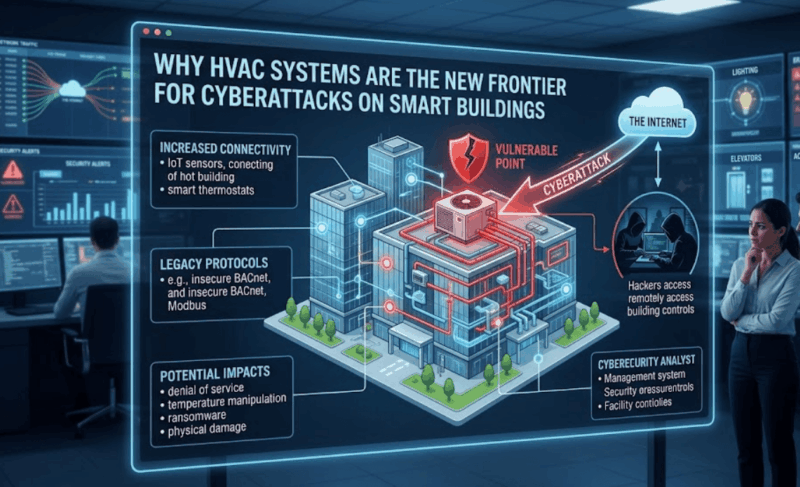
Why HVAC Systems Are the New Frontier for Cyberattacks on Smart Buildings

When most facility managers and IT security professionals think about cybersecurity threats, they picture hackers targeting servers, databases, or financial systems. Very few picture a thermostat. Yet today, heating, ventilation, and air conditioning systems have quietly become one of the most exploited entry points for cybercriminals targeting smart buildings. Building automation, cloud-based controls, and IoT infrastructure have transformed HVAC systems from simple mechanical units into fully networked endpoints. Consequently, they now carry serious, often overlooked risk.
This article breaks down why HVAC systems attract attackers. It also explores how these vulnerabilities get exploited, what the consequences look like for building owners and tenants, and what steps organizations can take to protect themselves before a breach occurs.
The Connected Building: How HVAC Systems Became Network Endpoints
The smart building revolution has been underway for more than a decade. Building owners adopted internet-connected HVAC controls because the benefits were undeniable: remote monitoring, automated energy optimization, predictive maintenance alerts, and centralized dashboards that made managing large facilities far more efficient.
To support these features, HVAC systems now integrate into broader building management systems (BMS). Furthermore, many connect to the same corporate networks that house sensitive business data. Sensors communicate over Wi-Fi and Ethernet. Controllers are managed via web interfaces. Vendors and contractors access systems remotely through VPN connections or, in less secure environments, through open remote desktop protocols.
Each connectivity point is a potential entry vector for an attacker. HVAC systems typically run on legacy firmware with infrequent security updates. Many units ship with default credentials that installers never change. Controllers often transmit data between sensors and dashboards without encryption. Taken together, these weaknesses create a target-rich environment for motivated attackers.
The 2013 Target data breach is the most cited example of this risk. Attackers stole credentials from an HVAC vendor and used them to reach Target’s payment card network. Ultimately, over 40 million credit and debit card records were compromised. More than a decade later, thousands of commercial buildings still use the same vulnerable architecture — and more connected devices come online every year.
Why Attackers Are Drawn to HVAC Infrastructure
Understanding why HVAC systems appeal to cybercriminals requires thinking like an attacker. In many sophisticated intrusions, the goal is not to hit the front door. Instead, attackers find a side entrance, establish a foothold, and move laterally until they reach high-value targets.
HVAC systems offer several qualities that make them ideal starting points.
Low visibility and monitoring gaps. In most organizations, IT security teams closely monitor servers, workstations, and enterprise applications. However, HVAC controllers and building automation systems often fall into a monitoring blind spot. Security information and event management (SIEM) tools rarely collect logs from HVAC platforms. As a result, attackers can operate inside these systems for extended periods without triggering any alarms.
Flat or poorly segmented networks. Many buildings place HVAC systems and corporate IT infrastructure on the same network without proper segmentation. Therefore, once an attacker compromises an HVAC controller, little may prevent lateral movement to email servers, file shares, or financial systems.
Persistent vendor access. HVAC manufacturers and contractors routinely maintain persistent remote access for support and diagnostics. If a vendor’s systems are compromised, that access becomes a direct pipeline into every building they service. This is precisely what happened in the Target breach, and it remains a common attack pattern today.
Physical consequences. Beyond data theft, compromised HVAC systems can cause real-world damage. An attacker controlling a data center’s temperature and humidity settings can trigger hardware failures. In hospitals and pharmaceutical facilities, manipulated HVAC systems can compromise temperature-sensitive medications or endanger patients. In office buildings, climate manipulation can serve as ransomware leverage: pay up, or lose a workable environment.
Real-World Consequences: More Than a Thermostat Problem
The damage from an HVAC cyberattack extends far beyond inconvenience. Organizations hit through building systems face consequences across multiple dimensions.
Data theft and regulatory exposure. If an HVAC network provides a path to systems containing personal, health, or financial data, the organization faces both breach costs and regulatory penalties under GDPR, HIPAA, or similar frameworks. Importantly, the original entry point does not reduce liability.
Operational downtime. Ransomware groups increasingly target building management systems. A successful attack can disable HVAC controls entirely, forcing facility closures until systems are restored. For hospitals, data centers, or manufacturers, even a few hours offline can mean millions in losses.
Reputational damage. When a breach becomes public, the entry point matters. A company that lets attackers in through a poorly monitored building system will face hard questions about its overall security posture from tenants, investors, and clients alike.
Cascading failures in critical infrastructure. Some of the most serious scenarios involve critical facilities. A cyberattack on HVAC systems in a utility control center, government building, or telecommunications hub could send consequences well beyond a single location.
It is also worth noting that routine physical maintenance — including periodic air duct cleaning (https://www.sanitairllc.com/) — brings third-party personnel into secure environments. Without proper security coordination, these visits can introduce new vulnerabilities to otherwise well-managed buildings.
Building a Defense: What Smart Buildings Need to Do Now
The good news is that HVAC cybersecurity risks are well understood and manageable. The challenge, however, is motivating organizations to act before a breach forces the issue.
Network segmentation is non-negotiable. HVAC systems and other operational technology should never share a network segment with corporate IT infrastructure. Proper segmentation — enforced by firewalls and access control lists — ensures a compromised building system cannot reach sensitive data environments.
Audit and rotate vendor credentials. Every third-party vendor with remote access should follow strict credential management policies. Specifically, this means unique credentials per vendor, multi-factor authentication, time-limited access tokens, and regular access audits. Organizations should replace persistent remote connections with just-in-time access wherever possible.
Treat HVAC controllers like IT endpoints. Facilities teams should apply firmware updates on a regular schedule, replace default credentials immediately upon deployment, and include HVAC systems in vulnerability scanning programs. Security and facilities teams must work together, rather than treating building systems as outside the cybersecurity scope.
Deploy monitoring for OT environments. Specialized operational technology security tools can provide visibility that traditional SIEM platforms lack. These tools detect unusual communication patterns, unauthorized configuration changes, and suspicious outbound connections — giving security teams early warning of potential intrusions.
Conduct regular security assessments. Building systems belong in annual penetration testing and security audits. Many organizations assume vendors handle security; vendors rarely do. Consequently, independent assessment is the only reliable way to find gaps before attackers do.
Develop an incident response plan for building systems. Most response plans focus on IT environments. Organizations with smart buildings should extend those plans to cover compromised HVAC or BMS scenarios — including shutdown authority, degraded operations procedures, and vendor coordination during active incidents.
Conclusion: The Time to Act Is Now
The cybersecurity risks in modern HVAC systems are not hypothetical. They are well-documented, actively exploited, and growing as buildings become more connected. The convergence of IT and operational technology has erased the boundary that once kept building systems safely isolated from corporate networks. That boundary is not coming back.
Organizations that treat HVAC security as a facilities issue rather than a cybersecurity issue leave a door open that attackers have proven, repeatedly, they know how to walk through.
The path forward requires collaboration between IT security teams, facilities managers, building owners, and vendors. Every networked device in a building is a potential attack surface. Organizations must move with urgency — because the threat landscape is not waiting for anyone to catch up.
Stay Informed With Cyber News Live
Cyber threats are constantly evolving, and staying informed is critical to protecting your organisation.
Follow Cyber News Live for the latest cybersecurity news, threat intelligence, expert analysis, and practical guidance to help strengthen your cyber defences.