
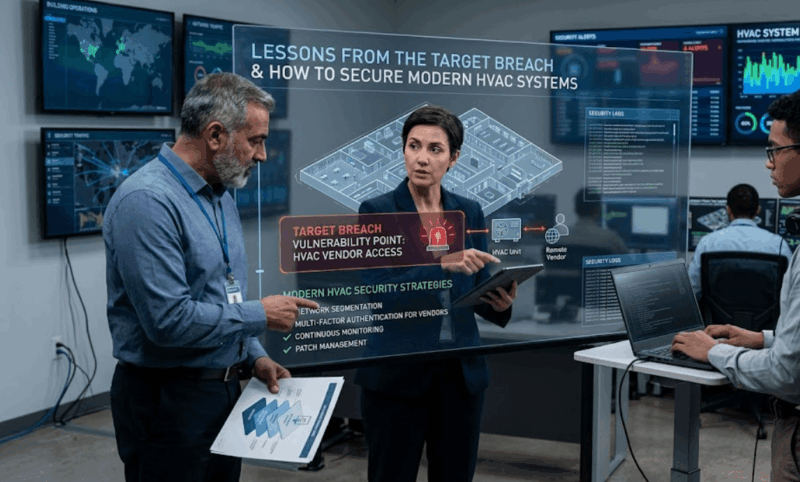
Lessons From the Target Breach and How to Secure Modern HVAC Systems

In late 2013, one of the most consequential data breaches in retail history unfolded, not through a phishing email or a zero-day exploit targeting a financial server. It started with an HVAC contractor, exposing a critical HVAC cybersecurity vulnerability that few organizations had considered. Attackers stole credentials from Fazio Mechanical Services, a Pennsylvania-based heating, ventilation, and air conditioning vendor. Within weeks, they had compromised the personal and financial data of approximately 110 million customers. The incident cost Target more than $200 million in settlements and remediation.
That single event changed how security professionals view operational technology. It proved that physical systems keeping buildings comfortable can serve as open doors into an organization’s most sensitive digital infrastructure. More than a decade later, the lessons remain urgent — especially as modern HVAC systems have grown far more connected and exposed than they were in 2013.
This article breaks down what happened at Target, why the same vulnerabilities still exist today, and what building owners, facility managers, and IT security teams can do to secure their climate control systems without sacrificing performance.
What Actually Happened at Target, and Why It Still Matters
Notably, the mechanics of the Target breach reveal a pattern that repeats constantly across industries.
Fazio Mechanical had remote access to Target’s network to monitor energy consumption and HVAC performance at store locations. This is standard practice. Vendors need visibility into the systems they manage, and remote monitoring reduces service costs compared to on-site visits. The problem was not the remote access itself. Rather, the problem was how that access was structured, governed, and monitored.
Attackers infected Fazio Mechanical’s own systems with malware and stole the vendor’s credentials. Once inside, they discovered the vendor’s remote access was not segmented from Target’s broader network. Instead of sitting in an isolated zone, the HVAC vendor portal shared network pathways with point-of-sale systems and cardholder data environments. Consequently, the attackers pivoted across that flat network architecture and eventually installed RAM-scraping malware on payment terminals throughout the store chain.
Target had security monitoring tools in place, and those tools generated alerts. However, the alerts were largely ignored. Ultimately, the combination of inadequate network segmentation, third-party credential failures, and insufficient alert response created the conditions for a catastrophic breach.
What makes this persistently relevant is that the same conditions exist in thousands of organizations today. Many buildings run HVAC systems on the same IP networks used for business operations. Vendors often manage access informally. Additionally, alerts from building management systems are treated as facilities issues rather than security events.
The Expanding Attack Surface of Modern HVAC Technology
The HVAC systems in use today are dramatically more sophisticated than those involved in the Target incident. Modern building management systems connect dozens of components — including chillers, air handling units, variable air volume controllers, building automation servers, energy dashboards, and remote monitoring platforms — all communicating over IP-based protocols.
This connectivity delivers real operational value. For example, predictive maintenance algorithms identify failing equipment before it causes an outage. Energy optimization routines can reduce consumption by 20 to 30 percent in commercial buildings. Cloud-based monitoring platforms give facility teams real-time visibility across multiple sites from a single dashboard. These are not trivial benefits.
However, each connected component is a potential entry point. Many HVAC controllers still run embedded operating systems with irregular or no security updates. Default credentials remain unchanged in a significant percentage of deployed systems. Communication protocols like BACnet and Modbus were designed decades ago for isolated building networks. They were never built with encryption or authentication in mind. When these protocols are exposed to IP networks without additional security layers, they transmit commands and data in plaintext.
The attack surface grows further with third-party integrations. A modern commercial building might connect its HVAC platform to an energy management service, a tenant comfort app, a facilities ticketing system, and a cloud analytics platform. Each integration creates a new dependency and a new potential weakness. Proper oversight of these integrations demands the same rigor applied to enterprise software procurement.
Remote access tools used by HVAC contractors add another layer of complexity. These tools vary widely in their security capabilities. Specifically, some vendors still rely on consumer-grade remote desktop software rather than enterprise VPN solutions with multi-factor authentication and session recording.
A Practical Security Framework for HVAC and Building Systems
Addressing these risks does not require replacing existing infrastructure. Instead, it requires applying structured security principles from the IT world and adapting them to the operational technology context.
Network Segmentation Is Non-Negotiable
The single most impactful step any organization can take is placing HVAC systems and other operational technology on isolated network segments with strictly controlled pathways to business systems. Security architects call this a demilitarized zone or OT network zone. Systems on this segment should communicate outbound to monitoring platforms through narrow, well-defined firewall rules. Inbound access should require explicit authorization and should not share pathways with corporate user traffic or payment systems.
Modern next-generation firewalls support deep packet inspection for protocols like BACnet. Therefore, security teams can filter commands at the protocol level rather than simply opening or closing ports.
Third-Party Access Management
Vendors and contractors should receive remote access through a privileged access management platform rather than through shared credentials stored in email threads. Each vendor should receive unique, time-limited credentials tied to a specific maintenance window. Sessions should be recorded and available for review. Access should be automatically revoked when a contract ends or a vendor employee leaves the organization.
This approach would have directly prevented the Target breach. Stolen vendor credentials would have been useless outside an authorized session window. Additionally, any anomalous activity would have appeared in session recordings.
Asset Inventory and Patch Management
Organizations cannot secure what they cannot see. Therefore, comprehensive asset discovery tools that identify HVAC controllers, building automation servers, and IoT sensors on the network are essential. Once assets are inventoried, firmware and software versions should be tracked against vendor security advisories.
Where patches are unavailable for legacy components, compensating controls should be applied — such as network isolation, protocol-level filtering, and anomaly detection. Replacing an aging pneumatic control system is expensive. Isolating it with a network access control policy, however, costs very little.
Security Monitoring That Includes Building Systems
HVAC and building management system events should feed into a centralized security information and event management platform alongside IT security data. Unusual command sequences, unexpected configuration changes, and access outside normal maintenance windows should all trigger investigation. The alerts that Target’s security team received but ignored would have carried far greater weight if building system events had been treated as security-relevant data rather than facilities noise.
Building a Culture Where Facilities and Security Teams Work Together
One of the quieter lessons from the Target breach is organizational. Facilities teams and IT security teams often operate in entirely separate silos. The people managing HVAC contracts and vendor relationships may have no visibility into network architecture. Meanwhile, the people monitoring security alerts may have no understanding of what building automation systems do or why unusual traffic from a BACnet controller should raise concern.
Bridging this gap requires deliberate effort. Joint risk assessments that include both facilities and security stakeholders can surface vulnerabilities that neither team would find working alone. Security awareness training for facilities managers — including modules on recognizing phishing attempts and managing vendor credentials safely — builds resilience at the operational level. Including building systems in annual penetration testing ensures isolated OT networks receive the same scrutiny as business applications.
Procurement processes should also evolve. When selecting HVAC vendors and building automation providers, security capabilities should be evaluated alongside performance specifications. Does the vendor support multi-factor authentication for remote access? What is their patch release cadence? Do they carry cyber liability insurance? These are now legitimate criteria for vendor selection.
Conclusion: The Thermostat Has Your Attention Now
The Target breach was a turning point. It demonstrated that the boundary between physical infrastructure and digital security had collapsed. Attackers will exploit any available pathway — no matter how mundane — to reach valuable data.
Modern HVAC systems save energy, extend equipment life, and improve occupant comfort in measurable ways. They are also complex, networked systems that deserve the same security investment organizations apply to their servers and applications.
The framework for securing them is well understood. Network segmentation, strong vendor access controls, systematic patch management, and integrated security monitoring can dramatically reduce the risk these systems represent. None of these measures require choosing between connectivity and security.
If your organization has not yet conducted a formal security assessment of its building systems and HVAC infrastructure, now is the time to begin. Review vendor access agreements, evaluate your network architecture, and bring your facilities team into the security conversation. The lessons from 2013 are still appearing in breach reports today. The organizations that take HVAC cybersecurity seriously will not be among them.
Stay Informed With Cyber News Live
Cyber threats are constantly evolving, and staying informed is critical to protecting your organisation.
Follow Cyber News Live for the latest cybersecurity news, threat intelligence, expert analysis, and practical guidance to help strengthen your cyber defences.